Have you ever wondered about the origins of knowing your future or understanding your inner self through the stars? Long before horoscopes became a daily newspaper staple, an ancient science called Jyotish – or Vedic Astrology – was meticulously developed on the Indian subcontinent. It’s not just a system of prediction; it’s a profound philosophy rooted in the understanding that the cosmos and human life are intrinsically linked.
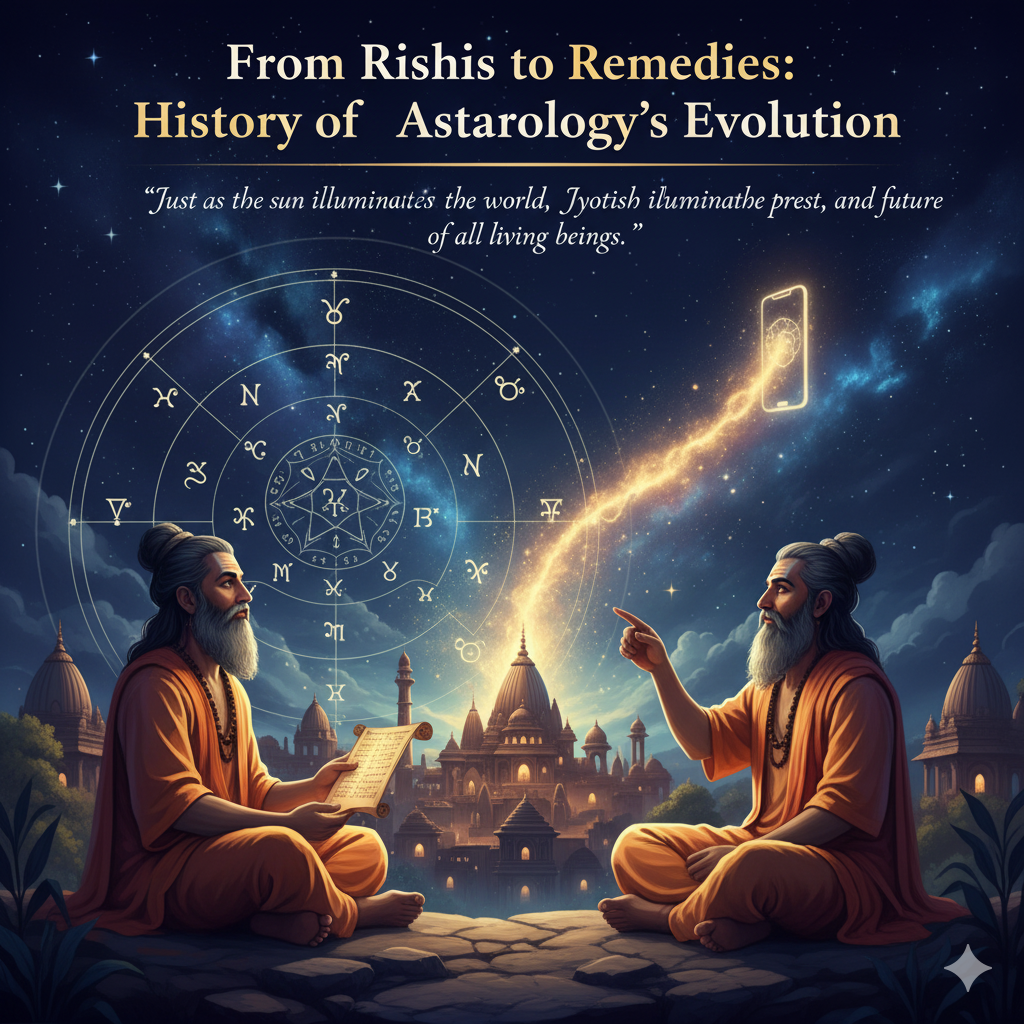
As the ancient text, the Brihat Parashara Hora Shastra, wisely states: "Just as the sun illuminates the world, Jyotish illuminates the past, present, and future of all living beings." This timeless quote captures the very essence of Vedic Astrology's purpose – to be a guiding light for humanity.
The Dawn of Cosmic Wisdom: The Vedic Period (c. 1500-500 BCE)
The earliest seeds of Jyotish can be traced back to the Vedas, the sacred texts of ancient India. These voluminous scriptures, composed by enlightened sages known as Rishis, contained hymns and verses hinting at astronomical observations and the influence of celestial bodies on earthly events and rituals. While not a fully formed astrological system then, this period laid the philosophical groundwork, emphasizing the interconnectedness of all things.
Imagine these Rishis, living in harmony with nature, gazing at the night sky, meticulously charting the movements of planets and stars. They weren't just observing; they were meditating on the deeper cosmic order, seeking to understand humanity's place within it.
The Golden Age of Jyotish: Classical Period (c. 500 BCE - 1200 CE)
This era marked the systematic development and codification of Vedic Astrology as we know it today.
Lagadha's Vedanga Jyotisha (c. 1400-1200 BCE, though sometimes dated later): Often cited as one of the earliest texts purely dedicated to astronomical and calendrical calculations, crucial for timing Vedic rituals.
The Rise of Siddhanta Texts: Works like the Surya Siddhanta (c. 400-500 CE) provided sophisticated mathematical models for planetary positions, eclipses, and other celestial phenomena – remarkably accurate for their time, demonstrating advanced astronomical knowledge.
The Astrological Giants: The works of great masters like Parashara (author of the Brihat Parashara Hora Shastra, a foundational text), Varahamihira (author of Brihat Samhita, covering a vast array of topics from meteorology to architecture alongside astrology), and Jaimini established the core principles, divisional charts (Vargas), planetary periods (Dashas), and predictive techniques that form the bedrock of Jyotish. These texts detail the influence of planets, houses, signs, and lunar mansions (Nakshatras) on individual lives.
During this period, Jyotish wasn't merely a fortune-telling tool; it was an integral part of daily life, used by kings for state matters, by families for auspicious timings of weddings, and by individuals for understanding their life's purpose and karma.
Enduring Through Time: Medieval & Modern Eras
Like many ancient sciences, Jyotish faced periods of decline and resurgence. Despite foreign invasions and cultural shifts, the wisdom was preserved through generations of dedicated scholars and oral traditions. In recent centuries, with increased global interest in Eastern philosophies, Vedic Astrology has experienced a significant revival.
The Numbers Speak:
While precise historical "user statistics" are unavailable, the sheer volume and preservation of manuscripts indicate widespread practice in ancient India.
Today, interest is booming. A 2021 survey by the Indian Institute of Public Opinion found that 78% of Indians believe in astrology, and a substantial portion consult astrologers for life decisions.
Globally, platforms like YouTube see millions of views on Vedic Astrology content, and dedicated apps have hundreds of thousands of downloads, showing a modern thirst for this ancient wisdom.
Jyotish Today: A Guide, Not a Decree
From the contemplative Rishis observing the cosmos to the intricate calculations of ancient scholars, Vedic Astrology evolved into a comprehensive system designed to provide insight, offer remedies (like specific gemstones or rituals), and guide humanity through life's journey. It helps us understand our karmic patterns, optimize our efforts, and live in greater harmony with universal energies.
It's a testament to its profound depth that this ancient science, born from celestial observations and spiritual insights, continues to offer relevant guidance to millions navigating the complexities of modern life. It reminds us that our personal stories are intricately woven into the grand tapestry of the cosmos.